
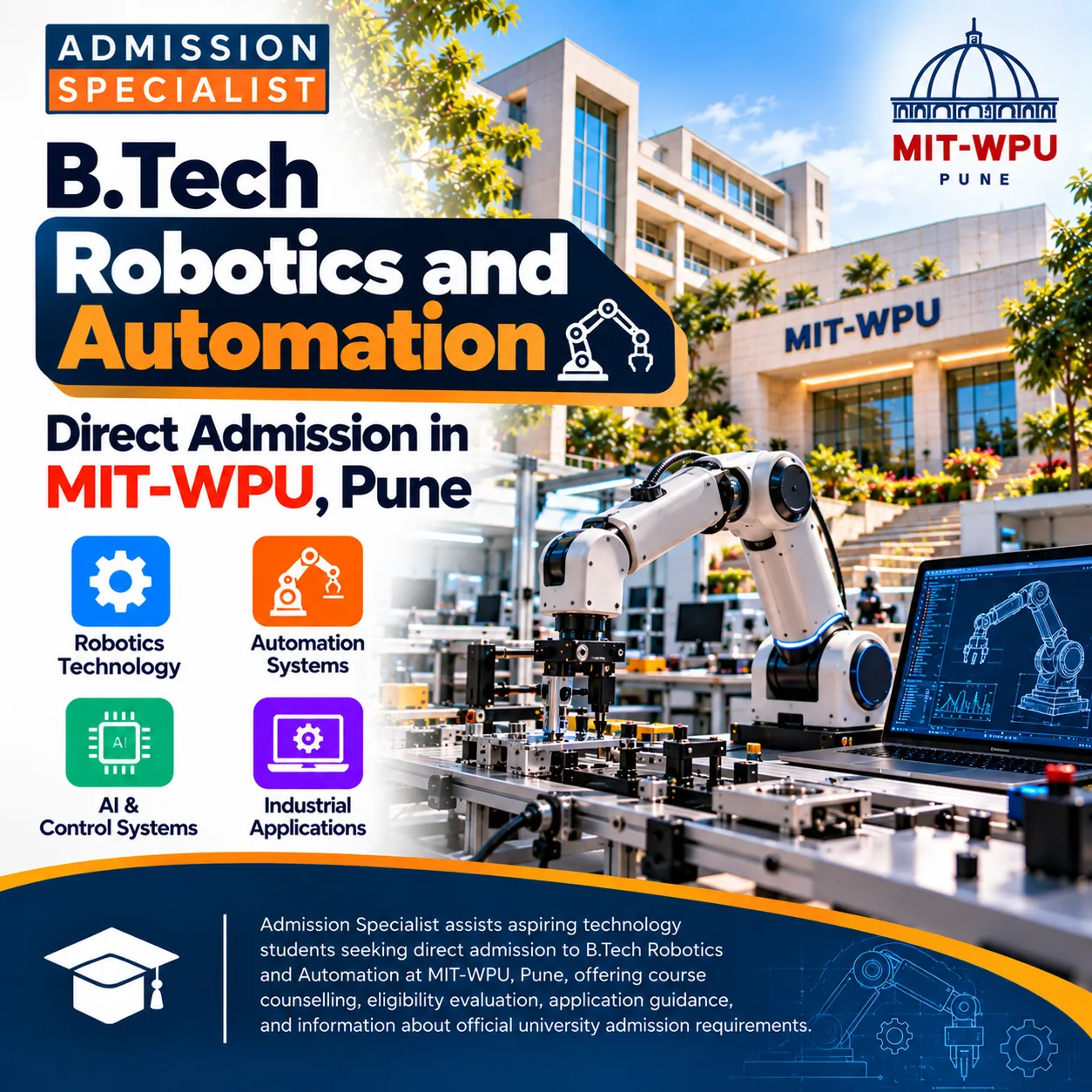
B.Tech Mechanical Engineering (Robotics and Automation) Direct Admission in MIT-WPU, Pune
B.Tech Mechanical Engineering (Robotics and Automation) Direct Admission in MIT-WPU, Pune
|
Specification |
Details |
|---|---|
| Course Name | B.Tech Mechanical Engineering (Robotics and Automation) |
| Degree | Bachelor of Technology |
| Course Level | Undergraduate Engineering |
| Duration | Typically 4 Years |
| Study Mode | Full-Time |
| Specialization | Robotics and Industrial Automation |
| Core Subjects | Robotics, Control Systems, Mechatronics, Industrial Automation |
| Programming Technologies | Robot Programming, Embedded Systems, PLC Programming |
| Engineering Applications | Robotic Manipulators, Automated Production, Smart Manufacturing |
| Design Tools | CAD, Simulation Software, Robotics Development Tools |
| Practical Learning | Robotics Laboratories, Automation Projects, System Integration |
| Eligibility | 10+2 with prescribed subjects and qualifying marks |
| Admission Process | As per university eligibility and selection criteria |
| Institution | MIT World Peace University (MIT-WPU) |
| Location | Pune, Maharashtra, India |
| Career Opportunities | Robotics Engineer, Automation Engineer, Control Systems Engineer |
Description
B.Tech Mechanical Engineering (Robotics and Automation) Direct Admission in MIT-WPU, Pune
B.Tech Mechanical Engineering (Robotics and Automation) at MIT-WPU, Pune, focuses on developing intelligent machines and automated systems that improve accuracy, productivity, and operational efficiency. The programme combines mechanical engineering with electronics, computer programming, sensors, and control technologies.
Key Programme Highlights
-
Robotic Mechanisms: Study the movement, structure, and working principles of robotic arms and mechanical systems.
-
Industrial Automation: Understand technologies that control production lines, manufacturing equipment, and industrial processes.
-
Mechatronics Engineering: Explore the integration of mechanical components, electronics, sensors, and computer-based control.
-
Robot Programming: Develop an understanding of instructions used to control robotic movements and operational tasks.
-
Control System Design: Learn how feedback mechanisms help regulate machine behaviour and maintain precision.
-
Sensors and Actuators: Examine components that detect environmental changes and convert control signals into physical movement.
-
PLC Technology: Discover how programmable logic controllers coordinate industrial machinery and automated workflows.
-
Machine Vision: Explore camera-based technologies used for inspection, object recognition, and robotic guidance.
-
Smart Manufacturing: Understand automated production environments, connected equipment, and data-driven industrial operations.
-
Hands-On Development: Apply engineering concepts through robotics experiments, automation prototypes, and system integration projects.
4. Admission Procedure
1. Verify academic qualifications: Review the prescribed Class 12 subjects, minimum marks, and any accepted equivalent qualifications.
2. Check entrance examination requirements: Confirm the applicable entrance tests, score criteria, and selection rules for the programme.
3. Register for admission: Complete the university application with accurate personal and academic information.
4. Arrange required documents: Prepare marksheets, identity proof, entrance examination details, and other documents requested by the university.
5. Complete selection formalities: Follow the instructions for assessment, eligibility verification, and any additional admission requirements.
6. Secure enrolment: Once an official offer is received, complete document verification and the prescribed fee payment within the specified deadline.
Reviews
There are no reviews yet.