
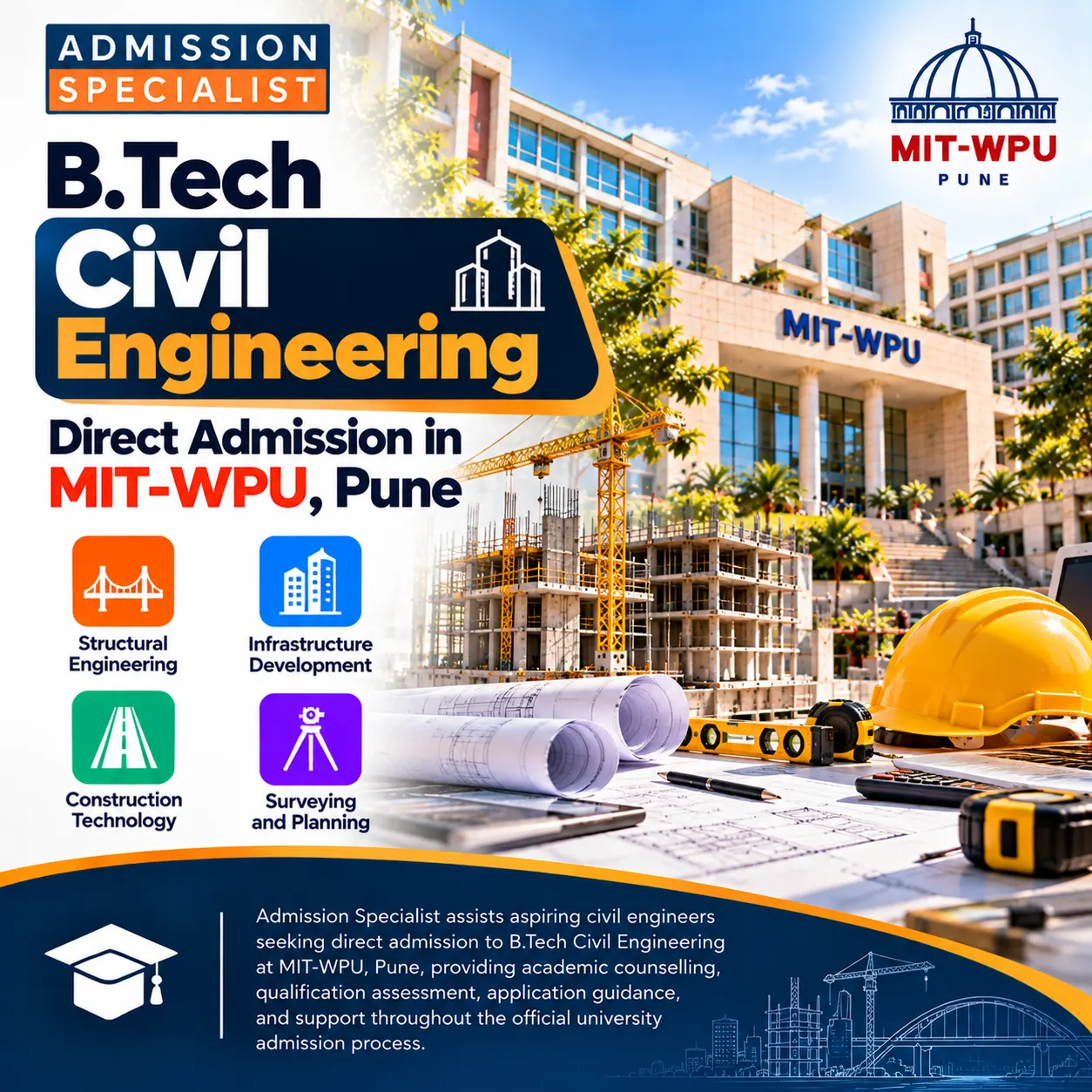
B.Tech Civil Engineering Direct Admission in MIT-WPU, Pune
B.Tech Civil Engineering Direct Admission in MIT-WPU, Pune
Admission Specialist assists aspiring civil engineers seeking direct admission to B.Tech Civil Engineering at MIT-WPU, Pune, providing academic counselling, qualification assessment, application guidance, and support throughout the official university admission process.
|
Specification |
Details |
|---|---|
| Course Name | B.Tech Civil Engineering |
| Degree | Bachelor of Technology |
| Education Level | Undergraduate Engineering |
| Course Duration | Typically 4 Years |
| Study Mode | Full-Time |
| Engineering Domain | Civil and Infrastructure Engineering |
| Core Subjects | Structural Analysis, Geotechnical Engineering, Hydraulics, Surveying |
| Construction Technologies | Building Materials, Concrete Technology, Construction Planning |
| Design Tools | AutoCAD, Civil 3D, BIM Software |
| Practical Training | Site Visits, Material Testing, Surveying Exercises |
| Eligibility | 10+2 with prescribed subjects and qualifying marks |
| Admission Process | As per university eligibility and selection criteria |
| Institution | MIT World Peace University (MIT-WPU) |
| Location | Pune, Maharashtra, India |
| Career Opportunities | Civil Engineer, Structural Engineer, Site Engineer, Project Engineer |
Description
B.Tech Civil Engineering Direct Admission in MIT-WPU, Pune
Admission Specialist guides students exploring direct admission to B.Tech Civil Engineering at MIT-WPU, Pune, offering personalised counselling, eligibility guidance, application assistance, and information about official admission requirements.
Key Programme Highlights
-
Structural Engineering: Understand how buildings, bridges, and other structures are designed to withstand loads and stresses.
-
Construction Materials: Explore the properties and applications of concrete, steel, aggregates, and other building materials.
-
Geotechnical Engineering: Study soil characteristics, foundation systems, and ground conditions affecting construction projects.
-
Surveying and Mapping: Learn techniques used to measure land, establish boundaries, and prepare construction layouts.
-
Water Resource Engineering: Explore water distribution, drainage systems, hydraulic structures, and resource management.
-
Transportation Engineering: Understand the planning and development of roads, highways, and transportation infrastructure.
-
Construction Planning: Develop knowledge of project scheduling, resource allocation, budgeting, and site coordination.
-
Computer-Aided Design: Gain familiarity with digital tools used to prepare engineering drawings and infrastructure designs.
-
Sustainable Construction: Examine approaches to resource efficiency, environmental protection, and responsible infrastructure development.
-
Practical Site Experience: Apply classroom concepts through laboratory work, technical surveys, site observations, and engineering projects.
4. Admission Procedure
1. Review academic qualifications: Check the prescribed Class 12 subjects, minimum marks, and other eligibility requirements.
2. Confirm entrance examination criteria: Review the accepted entrance examinations, qualifying scores, and applicable selection rules.
3. Submit the application: Complete the university’s admission form with accurate academic and personal details.
4. Prepare supporting documents: Arrange academic marksheets, identity proof, entrance examination records, and other documents requested by the university.
5. Complete selection formalities: Follow the instructions for academic assessment, document verification, and any additional admission requirements.
6. Confirm enrolment: After receiving an official offer, complete the prescribed fee payment and document submission within the specified deadline.


Reviews
There are no reviews yet.